
What are the emotional building blocks that make up complex emotions such as anger & sadness?
- Feb 17, 2022
- 2 min read
Updated: Feb 19, 2022
By Jorge A Cevallos, MD
February 17, 2022

The three archetypal -unconscious- emotions and building blocks for the rest of the more complex and subjective emotions are: fear, joy & disgust. Think of them as three lenses each tinted with a foundational color.
These three act as building blocks that mix and match together with our human subjective cognition to form more complex emotions such as anger and sadness.
Each of these archetypal emotions has a key survival purpose.
The three unconscious, archetypal and physiologic emotions are characteristic in that they happen so fast, we become aware of the emotion after it is already acting on our bodies physiologically.
Joy

Joy is one of the three archetypal unconscious and physiologic emotions that we feel before we know we have felt them.
The key neuromodulatory molecule (neurotransmitter) associated with Joy is Dopamine, which belongs to the catecholamine and phenethylamine families. Dopamine is made from I-tyrosine. As interesting context, foods high in dietary tyrosine include cheese, soybeans, beef, lamb, pork, fish, chicken, nuts, eggs, dairy, beans and whole grains.
Joy occurs when our unconscious situation appraisal realizes we have just reached a goal or met a physiological need such as survival and reproduction. Think how eating makes you feel joy!
Fear
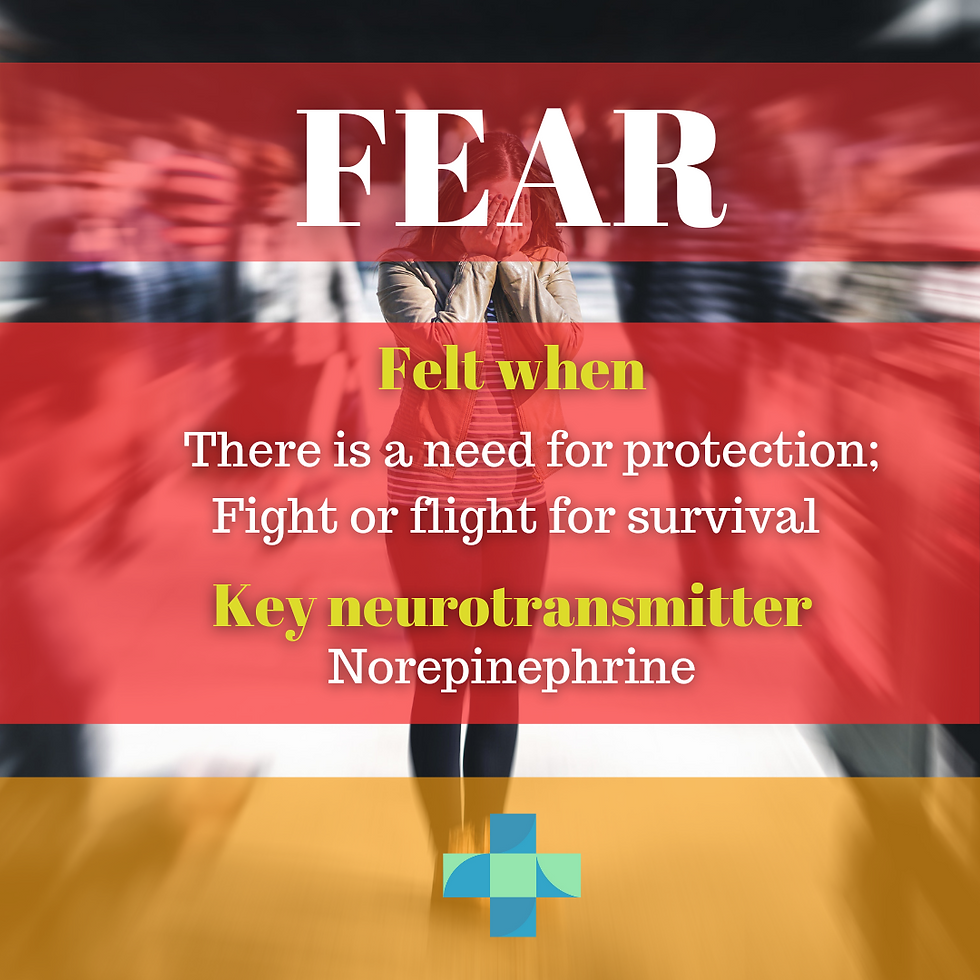
A danger becomes immediately apparent! What do you do? Fight or flight?
Fear is one of three unconscious archetypal emotions.These emotions unleash signalling molecules that fuel a physiological response that we experience before becoming aware we are feeling them. Fear can be thought of a sense of biological preparedness against objects unconsciously perceived as threats such as a rattling snake, a spider or fear of heights! Norepinephrine and the sympathetic nervous system are key regulators of fear. They cause blood flow to shift away from the abdomen to increase perfusion to the skeletal muscles, heart, lungs and limbs. Norepinephrine also induces processes to mantain blood glucose levels stable when the sympathetic response of fight or flight is triggered. This occurs given blood was shifted away from digestive organs.
Norepinephrine is made from l-tyrosine, just as dopamine is. Global increase in muscle tension indicates general readiness for action!
Obesity can induce higher than normal levels of norepinephrine.
Disgust

Disgust has the survival objective of avoiding toxic, decaying food. We therefore feel disgust when an object (e.g. food) fails to meet our physiological need of survival/self-preservation.
Serotonin is a signalling molecule (neurotransmitter) that neurons produce. Serotonin helps neurons communicate and is pervasive in the central nervous system (CNS) . Serotonin is found in elevated quanities in the digestive system and is involved with gut motility and the induction of nausea, among many other things. Serotonin is made from the essential amino acid tryptophan. Food sources rich in tryptophan include milk, canned tuna, turkey and tuna, oats, cheese and seeds.
Resources
1. Liang F, Feng R, Gu S, Jiang S, Zhang X, Li N et al. Neurotransmitters and Electrophysiological Changes Might Work as Biomarkers for Diagnosing Affective Disorders. Disease Markers. 2021;2021:1-12.


Comments